Human with AI
The impact of AI English conversation interface types on user experience, focusing on the moderating effect of proficiency.
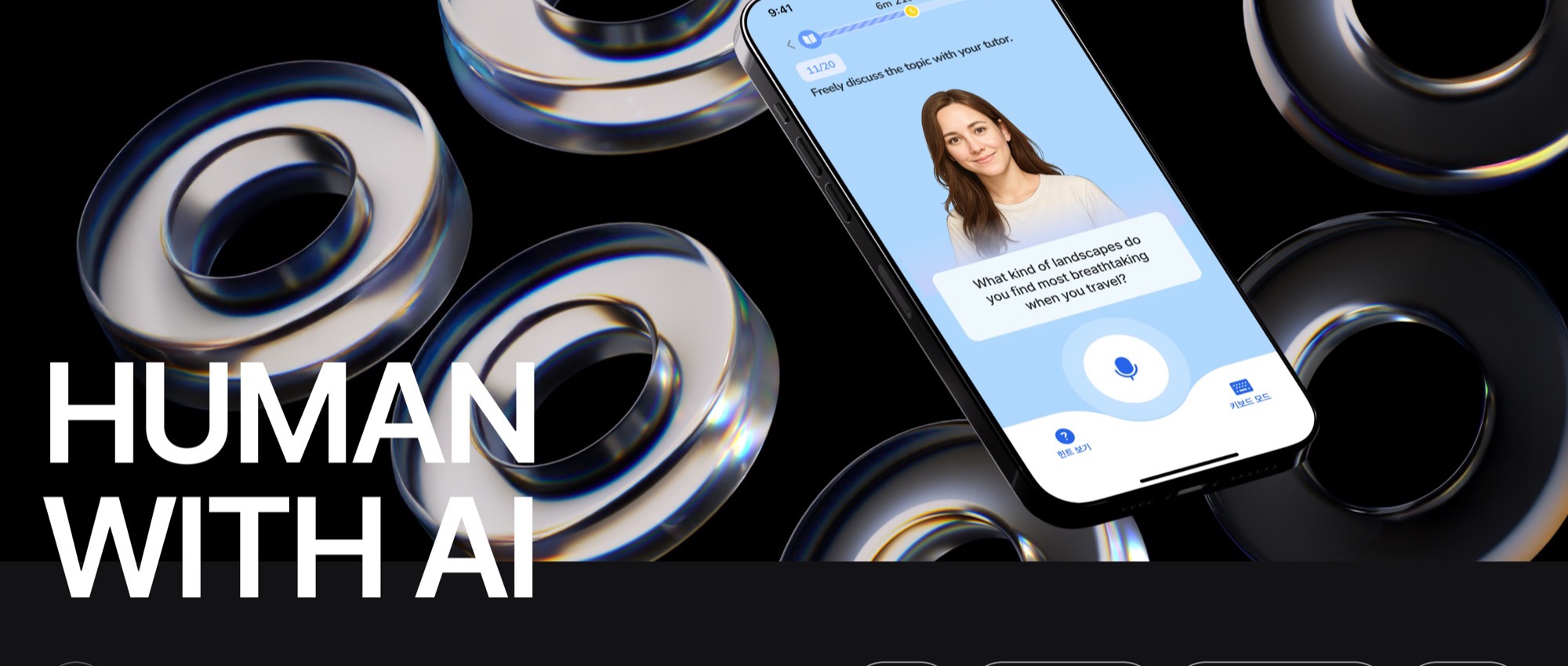
Impact
- Demonstrated that AI interface types affect immersion, cognitive load, and satisfaction differently depending on learner proficiency, providing empirical evidence for adaptive AI learning design.
- Identified a clear trade-off in human-like AI interfaces: higher immersion and satisfaction, but also a heavier psychological burden, especially for low-proficiency learners.
- Revealed that simplified, low-burden interfaces are more effective for beginners, providing actionable UX insights for personalized AI education platforms.
Role
UX Researcher / Product Designer
Timeline
May – Aug 2024 (3 Months)
Team
1 Researcher
Tools
Figma · Illustrator · Photoshop · SPSS / Excel
Contribution
Led research and design on AI-driven conversation prototypes, focusing on user immersion, cognitive load, and learning satisfaction across levels of anthropomorphism.
- Designed and tested four AI interface types (text, animal, avatar, human-like).
- Conducted quantitative and qualitative analysis with 100 learners.
- Created adaptive UI prototypes reflecting level-based insights.
01
Overview
Do different types of AI anthropomorphism affect users' learning outcomes?
This study analyzed how four types of conversational AI interfaces in English-speaking apps, voice/text-based, animal character-based, human character-based, and real human-based, influence learners' experience: immersion, cognitive load, and satisfaction.
The real-human interface produced the highest immersion and satisfaction but also raised users' psychological burden, while text- and voice-based interfaces offered a more stable experience for beginners. Designing the right level of anthropomorphism for a learner's proficiency and context is what improves both immersion and comfort in AI-assisted conversation learning.
02
Background
The rise of conversational AI in language learning
Conversational AI learning has drawn attention for enhancing efficiency and engagement beyond traditional methods. It offers learners a more immersive and sustainable experience that keeps them motivated.
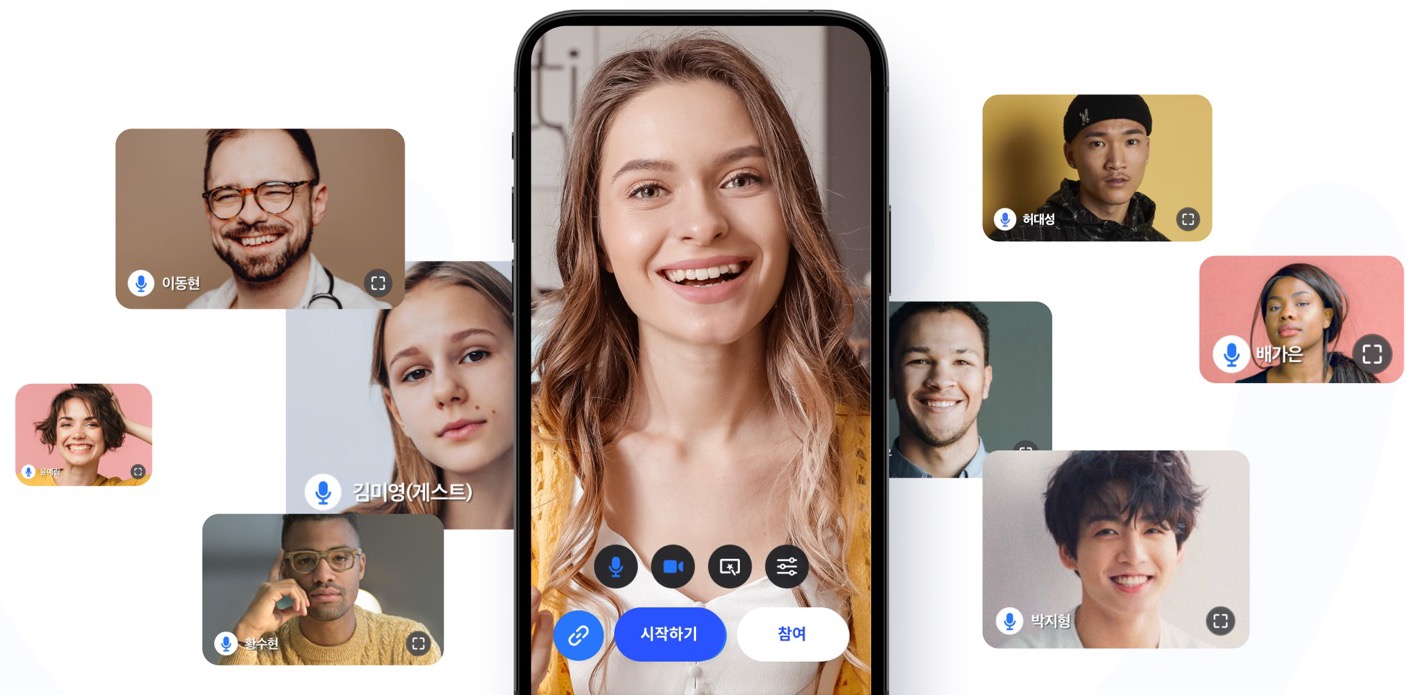
The debate on AI anthropomorphism
Proponents argue that anthropomorphism in AI enhances engagement and empathy, improving learning and service experiences. Opponents warn that human-like AI may raise ethical and credibility issues that lead to distrust.
Proponent
Ben Goertzel
Believes anthropomorphism can spark curiosity and emotional connection with AI.
Opponent
Dor Skuler
Warns about the risks of giving AI human-like forms and attributes.
03
Research Design
Building on prior research, the study analyzed how four types of anthropomorphism in English-speaking learning apps affect learner experience, with a particular focus on how the appropriateness of the dialogue type shapes engagement and satisfaction.
Independent variable
- AVoice / Text-based conversation
- BAnimal character-based conversation
- CHuman character-based conversation
- DReal human-based conversation
Moderating variable
Conversation proficiency
High / Low
Dependent variable
- 01Immersion
- 02Cognitive load
- 03Learning satisfaction
H1
Immersion, cognitive load, and learning satisfaction will differ by the anthropomorphism type of the AI interface.
H2
Conversation proficiency will moderate the relationship between interface type and learning experience.
04
Method
To support the survey findings, short in-depth interviews (under 20 minutes) were conducted with selected participants. High and low proficiency groups experienced identical AI conversation prototypes, and their immersion, emotional response, and satisfaction were compared across anthropomorphism types.
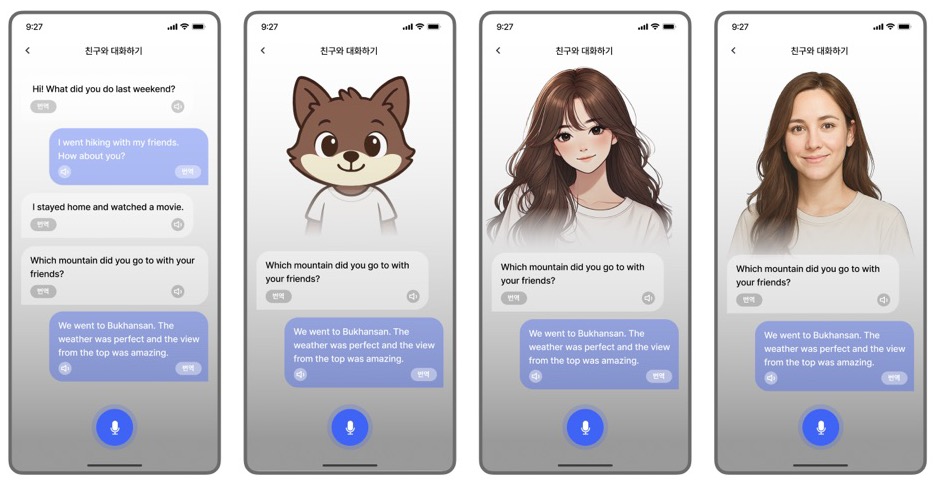

- Participants completed identical dialogue tasks on each prototype so that group differences could be compared.
- Based on a preliminary survey, participants were divided into high and low spoken-English proficiency groups.
- The experiment was designed to closely simulate a real learning environment to ensure ecological validity.
05
Results
Clear differences emerged across AI interaction types. Real human-based interfaces yielded the highest immersion and satisfaction but also the greatest cognitive load. Animal and human character AIs supported stable engagement, while voice/text-based AIs offered a low-burden experience for beginners.
H1 Insight
Real-human interfaces increased immersion and satisfaction but also imposed higher cognitive load.
Average scores by interface type (5-point scale)
View as table
| Type | Immersion | Cognitive load | Satisfaction |
|---|---|---|---|
| A · Voice / Text | 3.65 | 2.18 | 3.75 |
| B · Animal character | 3.50 | 2.37 | 3.50 |
| C · Human character | 3.43 | 2.68 | 3.05 |
| D · Real human | 3.80 | 2.57 | 3.85 |
H2 Insight
Beginners preferred text/voice-based AI, while advanced learners preferred real human-based AI.
Scores by proficiency level (5-point scale)
Immersion
Cognitive load
Satisfaction
View as table
| Type | Immersion · Beginner | Immersion · Advanced | Cognitive load · Beginner | Cognitive load · Advanced | Satisfaction · Beginner | Satisfaction · Advanced |
|---|---|---|---|---|---|---|
| A · Voice / Text | 3.80 | 3.50 | 2.10 | 2.26 | 4.00 | 3.30 |
| B · Animal character | 3.30 | 3.70 | 2.42 | 2.32 | 3.40 | 3.60 |
| C · Human character | 3.00 | 3.86 | 2.80 | 2.56 | 3.00 | 3.10 |
| D · Real human | 3.40 | 4.20 | 2.80 | 2.34 | 3.50 | 4.30 |
- 01ParticipantsOne hundred adult learners were split into high and low proficiency groups by a preliminary survey and took identical learning sessions across the four interfaces.
- 02Quantitative analysisA repeated-measures mixed-design ANOVA tested differences in immersion, satisfaction, and cognitive load across interface types and proficiency levels.
- 03Qualitative analysisIn-depth interviews surfaced the key experiential factors behind immersion and cognitive load.
- 04Hypothesis testingFive of the proposed hypotheses were supported and one was partially supported.
- 05Design implicationsConfirmed the need for interface strategies tailored to learner proficiency.
06
Proficiency-based UI
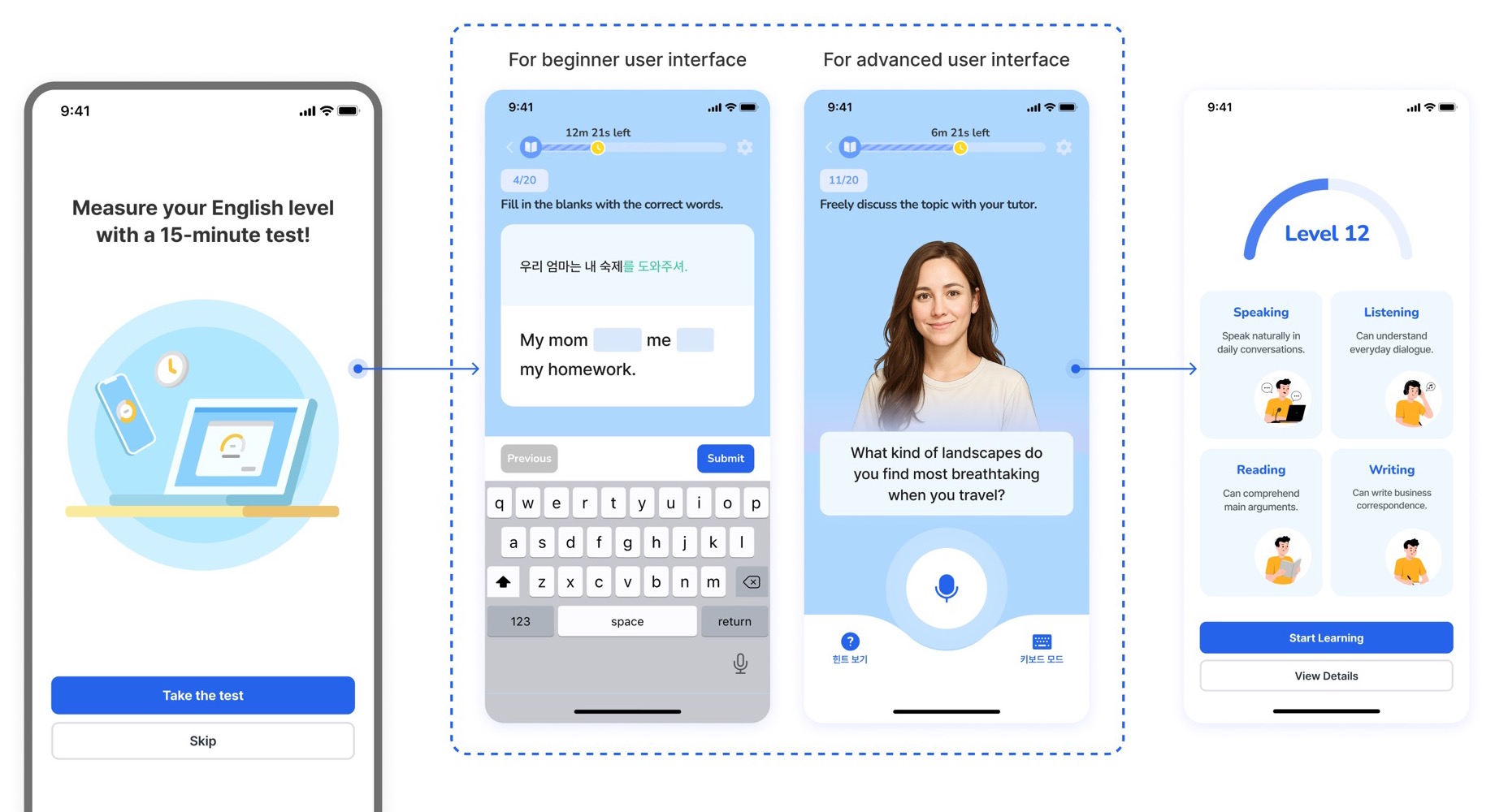
To improve learning outcomes, a 15-minute English placement test measures each user's proficiency before lessons begin. The AI then classifies learners by level and serves a UI optimized for it: low-burden text tasks such as fill-in-the-blank for beginners, and free conversation with a real-human tutor for advanced learners.
07
Lessons Learned
Language learning applicability
The balance between immersion and cognitive load extends to other language-learning platforms beyond the apps used here.
AI tutoring enhancement
The design framework can expand into multimodal interfaces for classroom and personal tutoring.
Personalized learning
Adaptive interfaces can tailor learning paths based on learner proficiency.
08
Full Paper
The complete research paper includes methodology, statistical analysis, and design implications across all four AI interface conditions.
View Full Research Paper ↗